Ganak: The Making of a Versatile, High Performance Model Counter

Ganak (github), our propositional model counter, has won every single model counting competition track for the past two years. Perhaps it’s time to explain how that came about, and what are the ingredients of such a tool. Firstly, a propositional model counter is a tool that counts how many solutions there are to a set of boolean constraints of the form:

a V b
b V -c

This set of constraints has the following possible solutions:

abc
---
000
001
010
011
100
101
110
111

But the ones highlighted in bold are not solutions, because the constraints make them incorrect. So we are left with 8-3=5 solutions. There is one more twist. Sometimes, we are only interested in the solutions over a set of variables, which we will call the sampling set, say “a” and “b”. Then we are only left with the solutions “01x”, “10x”, and “11x”, a total of 3 solutions, where “x” means we don’t care about the value , since it’s not in the sampling set.

The History of the Preprocessor: Arjun

Arjun (github) came about because we saw the B+E tool doing minimisation of the sampling set. Minimising the sampling set is important, because if the sampling set is e.g. only of size 10, then there are at most 2^10 things to count, but if it’s 20, then there are 2^20. It’s possible to minimise the sampling set sometimes: for example when we can prove that e.g. a=b, there is no need to have both “a” and “b” in the sampling set. Tricks like this can significantly lower the complexity of counting solutions. We enhanced B+E, and published this as a paper here.

In the end, it turned out that minimising the sampling set was really only the beginning: we also needed to make the input smaller. The fewer the constraints, and the fewer the number of variables, the easier it is to deal with the formula. This was not new to anyone, but it turns out that this minimisation was hard. Others have tried, too, but my advantage was that I came from the SAT world, with the CryptoMiniSat SAT solver under my belt, so I wrote an entire API (blogpost) for my SAT solver to be used as an input minimiser. This allowed me to try out many heuristics and write code easily, taking advantage of all the datastructures already inside CryptoMiniSat for constraint handling.

The History of the Counter: Ganak

The actual counter, Ganak (github), was something of another story. It started with a hack that my long-time collaborator Kuldeep Meel and I did in 2018, for a long evening and night in Singapore. This lead to the original Ganak paper which essentially added hashing to the system, thereby making it probabilistic, but also use a lot less memory, and thereby faster. I personally haven’t touched that project much, and instead focussed all my energies on the preprocessor, Arjun. I was pretty convinced that if I could make the preprocessor good enough, no matter what Ganak looked like, it would be good enough.

This strategy of focussing on Arjun mostly paid out, we did well in model counting competitions. The counter d4 was the main competitor at the time. Then SharpSAT-TD (paper) by Korhonen and Jarvisalo and came and it blew everything out of the water. That made me look at the Ganak source code first time in about 5 years, and I was appalled. We were putting a donkey, Ganak, on the rocket, Arjun, that I built, and we were doing OK, but looking at SharpSAT-TD, we were clearly racing a donkey against a cheetah. So In the spring of 2023 I sat down one morning and started replacing things I hated about Ganak, which was mostly everything.

Thus, the Ganak we know today was born. This gradual rewriting took about 2-3 years, continued during the summer and then the next spring. The most significant parts of this rewrite were that we cleaned up the code, added extensive fuzzing and debugging capabilities to it, added/adapted a lot of well-known SAT tricks for counting, integrated the tree decomposition (“TD”) system and parts of the preprocessor from SharpSAT-TD, and came up with a way to not only minimise the sampling set, but also the extend it, which can help in certain cases.

Ideas in Ganak and Arjun

We wrote a paper about Ganak (paper here) but to be honest, it only covers a very small ground of what we did. The change to Ganak between the original paper in 2019 to today is about 30’000 lines of code. Obviously, that cannot be explained in detail in just a few pages. Furthermore, the way academic publishing works, it’s not possible to simply list a bunch of ideas that were implemented — you need to explain everything in detail, which cannot be done with 30’000 lines of code. So, below is a bit of an “idea dump” that I have implemented in Ganak, but never published.

I might attempt at publishing some of them some day. Currently, I see little reward for doing so besides citations, and citations are not a great indicator in my view: lcamtuf is one of the best IT security professionals, ever, and has basically no citations. Besides, due to the “publish or perish” system in academia, there is a sea of research papers that most work gets lost in. I believe what matters most is performance and usability. Ganak does pretty well in this regard. It compiles to many platforms: Linux, Mac, both ARM and x86, and even emscripten in your browser. It supports more weight systems than other counters: integers, floats, exact rationals, complex numbers, primes, and multivariate polynomials over the rationals and floats. Ganak also uses less memory than other competing counters, while running faster. Besides, it’s regularly fuzzed and leaks no memory, so its output is rather trustworthy.

Without further ado, here are some ideas never published in Ganak, but which help the system run faster:

  • Using and improving the Oracle SAT Solver Korhonen and Jarvisalo (PDF by the authors). Oracle is a specialised SAT solver that allows one to query with many so-called “assumptions” in the SAT query, i.e. checking if something is satisfiable under conditions such as “a=true, b=false” — but many-many of them. This kind of query is very slow if you use a normal SAT solver, but with Oracle, it’s super-fast. This allows us to remove unneeded constraints, and make the constraints smaller. I improved this tool in a few ways, mostly by integrating a local search solver into it, that can drastically speed it up, by finding a satisfying solution much faster. I have also improved its heuristics, e.g. by using a better LBD heuristic (PDF by authors). I have also improved its solution cache, by employing cache performance tracking, pre-filtering, and cache size limitation. Besides, I added a step-tracking to it so it can be deterministically limited in time.
  • Improved version of tree decomposition originally by Korhonen and Jarvisalo (PDF here). This system computes the tree decomposition of a CNF via Flow-Cutter by Ben Strasser (PDF, code), however, the original system had a few issues. Firstly, it did a clock-limited run of the executable, which was unacceptable to me, as it makes the system non-deterministic: depending on the CPU it will run faster/slower thereby computing different values (it’s a local search algorithm, with many restarts). Also, running separate executables is very fragile. Secondly, and more importantly, it computed the tree decomposition of a CNF and then tried to find its centroid. But… what if the CNF was disjoint? What’s the single centroid of a forest? Slight issue. I fixed this by computing the top-level disjoint components and counting them separately. Although disjoint components sound really like an input issue, and not a counter issue, the problem is that our preprocessing is so strong that it can make a non-disjoint input into a disjoint input, thereby confusing the TD/centroid finding. Ooops.
  • Special-casing some inputs. Because we detect disjoint top-level components, sometimes we end up with CNFs that are very weird, for example, with a sampling set size of 2. These CNFs can only have at most 4 solutions, so counting them via the incredibly complicated d-DNNF system is an overkill, likely to waste a lot of time via the start-up and tear-down. Hence, these CNFs are counted one-by-one via the trivial use of a standard SAT solver.
  • Using CCNR by Shaowei Cai (PDF by authors) for speeding up the Oracle query. It’s a cool local search system, and it works really well. I wish I had fixed up its code because it’s a bit clunky and my colleagues gave me a hard time for it. Not research colleagues, of course. In research, quality of code is irrelevant — remember, only the number of citations matters.
  • Adapting Vivification by Li et al. (PDF paper) to the model counting setting. The original system stops the SAT solver once when the solver restarts, rewrites all the clauses to be shorter when possible, and continues happily every after. This happily ever after is impossible in a model counting setting, because we never restart. Slight issue. What I wrote was basically a nightmare-fuelled 2-week, probably about ~2000 line craziness that rewrites the propagation tree and/or avoids the clause improvement, so that all the invariants of the propagation remain intact while the clauses get shorter. This is kind of like changing the wheels on a car while it’s running. I don’t recommend doing this without extremely thorough fuzzing and debug tooling in place, or you’ll run into a lot of trouble. (By the way, this system not only contracts clauses, but also performs subsumption — if I have built the system, I might as well use it all the way)
  • Using an virtual interface for the Field we are counting over. With this system, the Field we are counting over becomes irrelevant for the counter. Instead, the counter can focus on counting, and the implementation of the interface can focus on the Field-specific operations. This has allowed me to add many-many Fields with very little overhead. The Field parses, prints, and handles the 0, and 1 points, and the + and * operators. This separation of concerns is I think the right way to go. Also, it allows someone to implement their own Field and use it without having to recompile anything.
  • Zero-suppressed Field counting. When counting over a field, there are two special elements one needs to take care of: zero and one. Of this, the zero is quite special, because a+0=a, and a*0=0. So, in Ganak, we don’t initialise the zero field element. Instead, we keep it as a null pointer. When manipulating this pointer, like adding or multiplying, we can simply replace it with a copy of what we add to it, or, when multiplying, keep it a null pointer. This saves space and also reduces the number of pointer dereferences we need to perform.
  • Extensive fuzzing infrastructure by Latour et al (code), with ideas taken from Niemetz at al (PDF here). Ganak and Arjun both have many options that allow the fuzzer to turn off certain parts of the system, or push them to the extreme, thereby exercising parts of them that would otherwise be impossible to reach. The paper I linked to explains how adding the options to the fuzzer, and setting them to all sorts of values, can help the fuzzer reach very hard-to-reach parts of the code, thereby exposing bugs in them easier.
  • Extensive debug infrastructure. Finding issues via fuzzing is only part of the deal, one must also be able to debug them. For this, Ganak has a 4-level debug system where progressively slower self-checking can be turned on so as to find the first place where the bug manifests itself as precisely as possible. The last level of debug checks every single node in the d-DNNF that Ganak builds, and exits out on the first node that the count is incorrect. The debug infrastructure also comes with a verbosity option that prints out full, human readable, structured, coloured logs for each major decision point in the d-DNNF. Overall, just the debug code of Ganak is likely 2-3 thousand lines of code. This may sound excessive, but Ganak can self-check its state at every node, and ensure that there is at least a path forward to counting the correct count, at almost all nodes. Apparently some have attempted to do what we did in our paper on Ganak, but bumped into issues they couldn’t resolve. I can confirm that without the appropriate fuzz and debug infrastructure, it would have been impossible for us to figure the things out we published in that paper.
  • Cache-optimised, lazy component finding. When a decision and propagation happens in the CNF, we must check whether the system has fallen into disjoint components. If so, we can count the components separately, and then multiply their counts — a property of a Field. This greatly helps in doing a lot less work. However, this means we must examine every single variable in the system, and see if it’s connected to the others through clauses at every node — often millions, or even 100s of millions of times during counting. Normally, d-DNNF counters do this by going through all the so-called occurrence list of all variables, recursively, and see if they encounter all variables. The issue with this is that it is extremely expensive, up to 50% of the total runtime, and furthermore, it re-examines parts of the clauses that were not touched by the newly set variables. However, it’s not easy to fix this: doing something very smart to a system that is very fast but dumb can slow down the system, since the smart thing can often take more time to compute than doing the dumb thing fast. So I pulled an old trick out of a hat, one that I learned from a paper by Heule et al.: time stamping. Basically, you keep a time stamp for each data element you touched, and as long as you can decide cheaply that you don’t need to recompute something based on the timestamp, you are good. We keep stamping each variable when its value is changed, and then we know what parts of the clauses need to be re-examined, based on the stamp on the clause and the stamp on the variable. I implemented this in a cache-optimized way, similarly how SharpSAT does it, laying it all out flat in the memory, putting clauses next to each other that will be dereferenced after one another — a trick I learned form MiniSat.
  • Prefetching of watchlists, and using blocked literals. Prefetching of watchlists is one of the very few things in SAT solving that was my idea. Basically, whenever a literal is set, its watchlist will be examined shortly. Hence, we can prefetch the watchslit the moment the literal is assigned, so as to prevent the CPU from stalling when the literal’s watchlist is invariably examined. This prefetching can be extended to the component finding, except there it’s occurrence lists and not watchlists. Secondly, I added blocked literals, another cache-optimising trick, by Chu et al (paper). Blocked literals are widely used by modern SAT solvers. SharpSAT missed it because it was written before this trick was known, so I added it in.
  • Recursive Conflict Clause Minimisation by Sörensson and Biere (paper). This was a trivial lift-and-shift from the MiniSat source code. There’s nothing much to say here other than it’s pretty well-known thing, but was not known at the time of SharpSAT. I believe there is nowadays a much better system by Fleury and Biere that does efficient all-UIP minimisation (paper). If you wanna lift-and-shit that code into Ganak and win the model counting competition, be my guest — all Ganak is always open source and online at all points in time, I have no energy to hide code.
  • Tight monitoring and management of memory usage. One of the first things you will notice with some model counters is that they eat all the RAM you have and then get killed by the kernel for lack of memory. This is unfortunately encouraged by the model counting competition guidelines which give massive amounts of memory, up to 64GB, to use by the counters. However, when you are testing your counter, almost all cluster systems have approx 4GB of memory per core (or less) in their nodes. The cluster I use has 160 cores per node and each node has 768GB of RAM, giving 4.8GB/core. Hence, if I want to test my counter without wasting resources, it should use at most 4.8GB of memory. Since I wanted to win the model counting competition, and for that I needed to test my system a lot, I optimised the system to use about 4.5GB memory at most. This is approx 10x less than what many other counters use. The way I did this is by (1) making sure no memory is leaked, ever, (2) precisely accounting for all memory usage and (3) deleting cache items that are occupying too much memory, ruthlessly. This required a using the valgrind memory leak detector, and a lot of use of valgrind’s massif heap profiler for many different types of inputs. This ensured that Ganak uses only the required amount of memory, and can safely and efficiently run in memory-constrained environments. In fact, Ganak would have won all tracks in both previous model counting competitions with only 1/10th of the allowed memory use (i.e. 6.4GB instead of 64GB).
  • A few more things that I can barely remember. For example, watchlists or clauses(?) were reverse-visited. Binary clauses were in the same watchlists as the normal clauses, but they can use a specialised watchlist and be visited faster. Clauses were removed from the watchlist using the “switch-to-the-end” trick which has been shown to be less efficient than simply overwriting. The original Ganak allocated memory for the component, hashed it, then deallocated the memory, but it could have called the hash in-situ, without the allocation, copy, and de-allocation. The original Ganak also used a hash function that was optimised to hash very large inputs, which made it impossible to compile to emscripten due to the CPU intrinsics used, and besides, it was unnecessary because it only had to hash a few KB at most. So I switched to chibihash64 by nrk.

The above took about 3-4 years of work, on-and-off, since I don’t normally get paid to do research. The total time I worked on Ganak being paid to do it was about 4-5 months. So it was mostly just passion and having some fun. The code at least is not absolutely unreadable, and there are a lot of seatbelts around, about 5-10% of the code is asserts, and there are entire sets of functions written solely to do self-checking, debug reporting, etc.

I will likely not publish any of the above ideas/improvements. Some are, I think, publishable, for example the the vivification, but especially that code is nightmare-inducing to me. The fuzzing and debugging while important to me, as I am interested in tools that work, is hard to publish and not too novel. Memory management again falls into this weird place where it’s not very novel but necessary for usable tools. Supporting many fields is just a basic requirement for a well-functioning system, besides, it’s super-easy to do, if set up right. The rest is just basic copy-paste with minor adjustment. I think the use of CCNR is actually quite fun, but I hardly think it’s worth a paper. It’s shaving 30-40% time off of a very slow-running (but necessary) part of the preprocessor, and I was very happy when I discovered it.

I hope you appreciated this somewhat long list. The code can of course be examined for all of them, and you can lift-and-shift some/all the ideas into other tools and other systems. I left quite a lot of comments, and if you turn on VERBOSE_DEBUG and set verbosity very high (say, “–verb 100”) you should be able to see how all of them work in tandem.

Ganakv2 Released

Finally, after many months of waiting for our paper to be accepted (preliminary PDF here), Ganak2 is finally released (GitHub code, released binaries) and easily accessible and modifiable. I wish this release had come earlier, but double-blind requirements didn’t allow us to release the code any sooner.

Basically, Ganakv2 has been re-written in many ways. Some of the original ideas by Thurley for SharpSAT has been kept alive, but many-many things are completely different and completely re-written — well over 10’000 lines of change in total. This set of changes has allowed Ganak2 to win every available track at the Model Counting Competition of 2024. In other words, Ganak2 is incredibly fast, making it a state-of-the-art tool.

Chonological Backtracking, Enhanced SAT solving, S- and D-sets

The new Ganak has a pretty powerful SAT solver engine with its own restart strategy, polarity and variable branching strategy. This SAT solver is tightly integrated into Ganak, and reuses the same datastructures a Ganak, hence the counter/SAT transitions are smooth. This relies on the observation that once every variable in the (minimal) independent set has been assigned, there is at most one solution, so we can just run a SAT solver, there is no need to a full-blown model counter. This idea has existed at least since GPMC, but we improved on it in important ways.

A very complicated but very important aspect of Ganak2 is our integration of Chronological Backtracking which we adopted to the model counting setting. This required a lot of attention to detail, and in order to debug this, we took full advantage of the fuzzer written and maintained by Anna Latour. We further added very serious and thorough checking into Ganak2, with varying levels of internal checking and per-node checking of counts. This allows to perform effective debugging: the first node that the count is incorrect will immediately stop and error-out, along with a full human-readable debug log of what had happened. This was necessary to do, as some of the issues that Chonological Backtracking leads to are highly non-trivial, as mentioned in the paper.

Ganak2 now understands something we call a D-set, which is a set of variables that’s potentially much larger than the projection set but when branched on, the count is the same. This allows Ganak to branch on far more variables than any other current model counter. We run an algorithm that takes advantage of Padoa’s theorem to make this D-set as large as possible. Further, Ganak2 takes advantage of projection set minimization, calling he minimal set an S-set, and running a SAT solver as soon as all variables from the S-set have been decided. This allows us to run a SAT solver much earlier than any other model counter.

Component Discovery, Subsumption and Strengthening, and Counting over any Field

Since the paper, I have also added a number of pretty interesting improvements, especially related to component generation, which is now a highly cache-optimized datastructure, using time stamping, a trick I learned from Heule et al’s brilliant tree-based lookahead paper (worth a read). I also changed the hash function used to chibihash, it’s not only faster (on the small inputs we run it on) but also doesn’t rely on any specific instruction set, so it can be compiled to emscripten, and so Ganak2 can run in your browser.

There is also a pretty experimental on-the-fly subsumption and strengthening that I do. It actually rewrites the whole search tree in order to achieve this, which is a lot harder to do than I imagined. It’s the most trivial subsumption & strengthening code you can imagine, but then the rewriting is hell on earth. However, the rewriting is necessary in case we want to be able to continue counting without restarting the whole counting process.

Ganak, unlike many of its counterparts, also manages memory very tightly and tries not to die due to memory-out. The target memory usage of the cache can be given via –maxcache in MB. A cache size of 2500MB is default, which should cap out at about 4GB total memory usage. More cache should lead to better performance, but we actually won (every available track of) the Model Counting Competition 2024 with rather low memory usage, I think I restricted it to 8-12GB — other competitors ran with ~2x that.

Furthermore, Arjun, our CNF minimizer has also been tuned. While this is not specifically Ganak, it gives a nice improvement, and has some cool ideas that I am pretty happy about. In particular, it runs the whole preprocessing twice, and it incorporates Armin Biere’s CadiBack for backbone detection. I wish I could improve this system a bit, because sometimes CadiBack takes >1000s to run, but without it, it’s even slower to count in most cases. But not always, and sometimes backbone is just a waste of time.

The system also now allows to use any field, all you need to do is implement the +/-/*/div operators and the 0 and 1 constants. I have implemented integers, rationals, modulo prime counting, and counting over a the field of polynomials with rational coefficients. All you need to do is override the Field and FieldGen interfaces. I made it work for modulo prime counting in under 20 minutes, it’s like 30 lines of code.

Floating Point Numbers

Notice that floating point numbers don’t form a field, because 0.3+(0.2+0.1) is not equal to (0.3+0.2)+0.1, i.e. it’s not associative (– thanks to Martin Hořeňovský for this correction, previously I said “commutative”). Actually, Ganak2’s weighted model counting doesn’t currently support floating point numbers, because it doesn’t need to — we won literally every available track with infinite rational numbers: 0.3 is simply interpreted as 3/10. This sounds minor, but it also means that it’s actually trivial to check if Ganak runs correctly — it simply needs to be run with a different configuration and it should produce the same solution. Notice that this is not at all true for any other weighted model counter. Literally all of them, except for Ganak, will give different solutions if ran with different seeds. Which is hilarious, since there is obviously only one correct solution. But since 0.3+(0.2+0.1) is not equal to (0.3+0.2)+0.1 in floating point, they can’t do anything… rational.

This whole floating point saga is actually quite annoying, as it also means we can’t check Ganak against any other counter — at least not easily. All other counters give wrong answers, given that floating point is incorrect, and so we can only compare Ganak2 to other counters if we allow a certain deviation. Which is pretty hilarious, given that counters all claim to use “infinite precision”. In fact, the only thing infinite about their results is likely the error. Since (0.3+(0.2+0.1)) – ((0.3+0.2)+0.1) is not 0, it is actually possible to have theoretically infinite error in case of negative weights.

Approximate Counting and Ganak

Ganak2 incorporates ApproxMC, and can seamlessly transition into counting via approximate model counting methods. To do this, simply pass the “–appmct T” flag, where T is the number of seconds after which Ganak will start counting in approximate mode. This can only be done for unweighted counting, as ApproxMC can only do unweighted counting. However, this seamless transition is very interesting to watch, and demonstrates that using a multi-modal counting framework, i.e. exact+approximate is a very viable strategy.

What happens under the hood is currently unpublished, but basically, we stop the exact counting, check how much we have counted so far, subtract that from the formula, and pass it to ApproxMC. We then get the result from ApproxMC and add the partial count that Ganak counted, and display the result to the user. So the final count is partially approximate, and partially exact, so we actually give better approximation (epsilon and delta) guarantees than what we promise.

Compiling Ganak

The new Ganak incorporates 8 libraries: GNU MP, CryptoMiniSat, Arjun, ApproxMC, SBVA, CadiCal, CadiBack, and BreakID. Furthermore, it and compiles in (optinally) BuDDy, Oracle (from Korhonen and Jarvisalo) and Flowcutter. These are all individually mentioned and printed to the console when running. However, this means that building Ganak is not trivial. Hence, with the very generous help of Noa Aarts, Ganak has a flake nix, so you can simply:

git clone https://github.com/meelgroup/ganak
cd ganak
nix-shell

And it will reproducibly build Ganak and make it available in the path. All this needs is for one to have installed Nix, which is a single-liner and works incredibly reliably. Otherwise, the Ganak repository can be cloned together with its GitHub Actions, and then each push to the repository will build Ganak2 for 4 different architectures: Linux x86&ARM, Mac x86&ARM.

Submit your Version of Ganak to the 2025 Competition

Ganak2 is highly extensible/modifiable. I strongly encourage you to extend/change/improve it and submit your improvement to the Model Counting Competition of 2025. Deadline is in 3 weeks, it’s time to get your idea into Ganak and win. I promise I will have all my changes publicly available until then, and you can literally submit the same thing I will, if you like. I’d prefer if you put in some cool change, though.

Ethereum in the age of AOL

Imagine you are super-excited about some new technology that’s enabled by the internet, say, Google, and instead of investing in Google, i.e. buying Google stock, you start buying AT&T stock. Or let’s say Facebook just came out, and it’s the hottest thing. Everyone wants Facebook. So instead of investing in Facebook stock, you start buying AT&T stock. It’d be just weird, right? But that’s what seems to be happening in the crypto space.

The more I spend in this space, the more I’m baffled by people buying and holding ETH, the native currency of Ethereum, hoping that if the next Facebook comes around, the value of ETH will go up. And to be fair, AT&T and Cisco stock probably did go up when Netflix became popular. But ultimately, AT&T, Cisco, T-mobile — they are just the underlying pipes. Sure enough, Cisco should go up somewhat when Netflix is becoming popular, because you definitely need routers to watch Netflix. But we all understand that the Internet is just the piping.

This is reminiscent of AOL. Back in the dark ages of the Internet, AOL was “the” internet, it provided all the services in one place. From directory to mail services. If you wanted to invest in the internet, you bought AOL stock. But that’s no longer the case, and for a good reason.

Electricity, the Internet, and Infrastructure

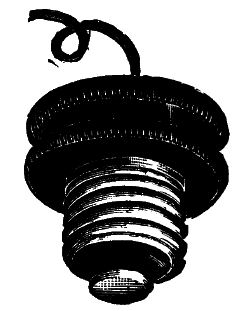
Electricity plug designed to fit into a socket for light bulbs

I think most people would find it rather insane to buy electricity suppliers’ stocks when a new type of home appliance, say robot vacuums come around. However, electricity stocks were a big deal back in the day. The original use-case for electricity at home was light bulbs. Light bulbs were huge — lighting was expensive (you had to get candles or oil) and was painful to light up, and sometimes it burned down buildings. In fact, the original washing machines’ electric plugs actually plugged into a socket for light bulbs! You had to screw it in — and unscrew it in case there was an accident. Which was very-very dangerous, hence the new sockets that are very easy to unplug. But it’s interesting to observe that there was an original use-case, and it was so popular that “electricity”just straight up meant light bulbs, and nothing else.

The original use-case of cryptocurrencies was liquid, fast transfer of fungible value over the network without a central system. But we moved way beyond that now. We have currencies and banks operating over Ethereum. We have casinos and online games and betting platforms. We have exchanges and brokers. However, somehow people still hope that the infrastructure value will go up.

Hoping your AT&T bill goes up

Imagine buying a monthly internet subscription from AT&T and hoping that the subscription costs go up. That’s what’s happening in crypto. The native currency of Ethereum is used to regulate the transactions on the chain, so that the competition of which transaction makes it into the chain can be decided. When you hold ETH, you are effectively hoping that transaction costs go up. It’s like hoping that your AT&T bill gets higher. Who the hell would want that? It’s infrastructure cost, it’s not supposed to go up over time. It’s supposed to go down.

The secondary use-case of ETH is the consensus protocol, making sure the things that do make it into the transaction block are what one would more or less expect. So it’s used to also secure the chain in a manner that’s called Proof-of-Stake. Here, the value of ETH is used to make sure it’s not economically viable to cheat. However, it wouldn’t be too difficult to move staking to stablecoins such as Dai, or other value-holders, e.g. a combination of the most used systems on the chain. After all, it’s in everyone’s best interest for the most value-generating systems to survive.

Betting on success

In my view, if you want to bet on the crypto system to be successful, you need to start betting on not only ETH, but much more importantly all the systems that make Ethereum useful. Looking at e.g. a DeFi token list is a good start. Ultimately, the internet is not useful because of AT&T. It’s useful because of email, websites, and online systems such as Ethereum itself, which wouldn’t exist without the Internet. Yet I’m pretty sure ETH holders are not in a rush to buy AT&T stock. In the same vain, they should not be in a rush to buy ETH. Rather, they should be investing in all the systems and tools built on top of Ethereum. Ethereum is “just” the infrastructure, similarly how the internet on which Ethereum runs, is “just” the infrastructure, which itself is built on electricity, which is “just” the infrastructure. Sure, we need the infrastructure. And we need to invest in the infrastructure (I have a separate rant on how little is actually being invested by anyone other than the Ethereum Foundation). But only investing in the infrastructure, and not on the systems built on top of it, is weird.

Post Scriptum: Bitcoin

Bitcoin is forever stuck at being electricity for light bulbs only. Make of that what you will. Light bulbs are useful, of course. But I’m typing this on a computer, that’s connected to the internet, and my light bulbs are not even on. If electricity was only capable of lighting the light bulb, and not powering my computer, my router, and the system of routers that route my packets to you, we would still be writing&reading articles in physical newspapers, and sending mail via physical post.

References

You may be interested in this article and this tweet thread for ideas and thoughts that others had independently, but well before me. Thanks to M. at the EF for these references, they are actually really relevant. I’m glad others are seeing things similarly to me.

Computing Tricky Probabilities

Probabilities of certain events are really hard to estimate sometimes. Often, it’s because we lack information of the underlying causal chains, but sometimes, it’s because the causes are so intertwined that even if we know the underlying probabilities of certain events happening along with the causal chains, it’s still impossible for us to untangle the web.

Let’s say there’s an event X has a probability of 0.4, Y has a probability of 0.6, and Z happens if either X or Y happens, but X and Y can’t happen at the same time, with a probability of 0.8. What’s the probability of Z happening?

             0.4                  0.6          
         ┌───────┐            ┌───────┐       
         │       │    0.8     │       │       
         │   X   │◄────!─────►│   Y   │       
         │       │            │       │       
         └──┬────┘            └────┬──┘       
            │                      │                    
            │      ┌───────┐       │          
            │      │       │       │          
            └─────►│   Z   │◄──────┘          
                   │       │                  
                   └───────┘  

Translating to a Model Counting Problem

The solution is easy to compute if you know how to use propositional model counters. They allow you to create a set of rules, such as:

X = 0.4
Y = 0.6
X or Y = True
0.8 -> NOT (X & Y)

The above perfectly describes the probability landscape, by using “->”, i.e. implication (if the left side is true, the right side must also be true), and using “&” (i.e. logical AND). Basically, for Z to happen, X or Y has to happen. And with probability 0.8, they must not happen at the same time. To solve the above, we add a helper variable H1, that will allow us to translate the last equation into an implication:

X = 0.4
Y = 0.6
X or Y = True
H1 = 0.8
H1 -> NOT (X & Y)

To translate this to propositional model counting, we can do the following, where “-” is negation:

weight X = 0.4
weight Y = 0.6
weight H1 = 0.8
X or Y = True
-H1 or -X or -Y = True

The highlighted lines are what’s call the Tseitin transformation, which basically means that when H1 is TRUE, (NOT X or NOT y) must be TRUE, i.e. at least one of them has to be FALSE, i.e. they can’t happen at the same time (but it’s possible that neither of them happens). The above is what’s called a conjunctive normal form, or CNF for short.

The model counting DIMACS representation (formal description here) of the above is:

c t pwmc
p cnf 3 2
c comment X = 1, Y = 2, H1 = 3
c p weight 1 0.4 0
c p weight 2 0.6 0
c p weight 3 0.8 0
1 2 0
-3 -1 -2 0
c p show 1 2 3 0 

Which is a straightforward 1-to-1 translation of the above, except we have to tell the counter that this is a projected weighted model counting problem (“pwmc”) and that it has 3 variables, and 2 constraints (“p cnf 3 2”).

Solving with a Model Counter

Once you have a CNF representation, you can run a modern propositional weighted model counter to count the number of weighted solutions, i.e. the probability of Z. I recommend the one I develop, ganak (linux binary here, open source code will be available soon, ask me if you need it):

./ganak problem.cnf
c s type pwmc
s SATISFIABLE
c s exact arb float 5.68E-01

So Z has a probability of 0.568. This can easily be verified to be correct:

Python 3.13.1
>>> 0.6*(1-.4)+0.4*(1-0.6)+0.4*0.6*(1-0.8)
0.568

Which adds up the probabilities that the left fires (but not the right), the right fires (but not the left), and that both fire, but the conflict does not happen (with 1-0.8 probability).

Of course, the above is a rather simple problem. However, with the above steps, one can create arbitrarily complicated causal chains, with complex constraints between partial, or intermediate elements of the chain, conditional probabilities, etc. Although there are limits to scalability, it’s many-many orders of magnitude faster than anything by hand, or by some form of brute-force checking/estimation.

Use-cases

In certain scenarios, it’s really important to know what the probability of some event is. For example, if you want to run a hazardous process such as a nuclear reactor or a chemical plant, or you want to provide insurance for some complicated (financial) product, accurately computing the probabilities of bad events happening is extremely important. I think it’s rather obvious that nuclear plants have very complicated causal chains for bad events happening — and they tend to be intertwined. If the external power lines are damaged, then likely it’s a major event (e.g. earthquake) and you likely also lost the majority of your transport capabilities, and along them, much of potential external help.

Similarly, if you want to bet for/against market moves, where you know or have a good idea of the underlying causal chains and associated probabilities, you can build quant trading, or expert advice systems based on the above. In other words, weighted model counting is not only useful for party tricks. Complex probability chains with thousands of interdependent random variables can easily be analyzed using the above system.

Some food for thought: great content on the Internet

The Internet is a pretty vast place. So I decided to curate a few links for you all for this special end-of-year period:

Ágnes Dénes – Wheatfield – A Confrontation, 1982, Battery Park Landfill, Downtown Manhattan, photo: John McGrall